

Foreign National Loans
The Foreign National Loan Program helps eligible non-U.S. citizens finance investment properties and vacation homes in the United States. Flexible qualification options may be available using rental income, assets, or financial documentation from your home country.
Rateplicity compares programs from multiple lenders to help you find competitive financing suited to your property and financial profile. Contact us today for a free, no-obligation consultation.
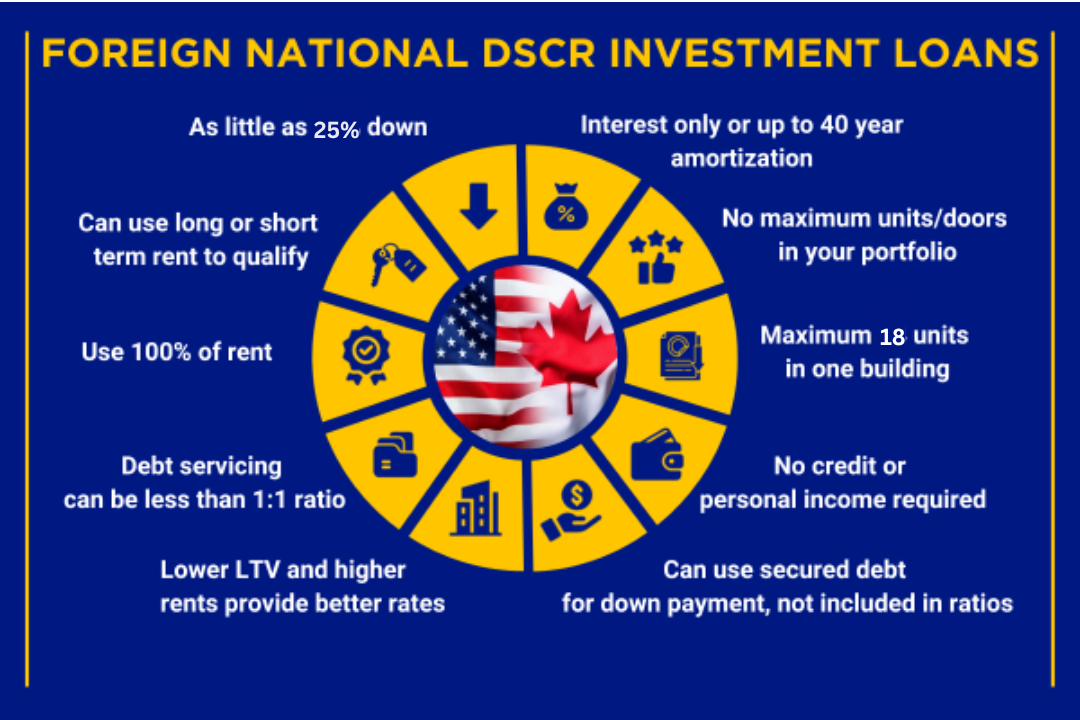
Flexible Financing for your U.S. Property
Competitive Down Payments
Down payment options starting at 20% are available for qualified borrowers.
Flexible Debt Servicing
Less than a 1:1 ratio allowed (Rental income may be lower than the property’s monthly mortgage payment)
Flexible Income Qualification
Qualify using eligible income from short- or long-term property rentals.
Income/Credit
Available without U.S. credit history or traditional income verification.
No Portfolio Limit
No limit on the number of financed properties you may own.
Down Payment and Mortgage Terms Flexibility
Multiple funding sources may be permitted, including borrowed funds. Interest-only options and amortization terms of up to 40 years may also be available.
Need Help Deciding?
Schedule a free, no-obligation consultation to explore foreign national mortgage options tailored to your needs.
Foreign National Loan Program FAQs
How should I own my U.S. property?
The way a U.S. property is titled can affect your mortgage, taxes, estate planning, and what happens to the property if you die or become unable to manage your affairs.
There is no single ownership structure that is right for every Canadian buyer. The appropriate structure depends on your personal circumstances, how the property will be used, the financing being arranged, and your Canadian and U.S. tax and estate-planning objectives.
What are the most common ways Canadians can own U.S. property?
Depending on the circumstances, Canadians may own U.S. real estate:
- Individually
- Jointly with a spouse or family member
- Through certain trusts
- Through an LLC
- Through another ownership arrangement
The appropriate structure can depend on who is purchasing the property, whether it will be used personally or as an investment, whether financing is required, the lender’s ownership requirements, the size of the buyer’s worldwide estate, and Canadian and U.S. tax considerations.
It can also depend on who will eventually inherit the property.
Do I need both a Canadian and U.S. will?
Possibly, but the more important issue is making sure your Canadian and U.S. estate-planning documents work together.
Simply preparing a separate U.S. will without reviewing your existing Canadian will can potentially create problems if the documents contain conflicting instructions.
Ideally, the Canadian and U.S. professionals preparing your estate plan should both know that you own assets in the other country.
The objective is to create an estate plan in which all of the documents work together.
Can a Canadian be subject to U.S. estate tax?
Yes.
Canadians should not assume that U.S. estate-tax rules do not apply simply because they live in Canada.
U.S. real estate is generally considered a U.S.-situated asset.
For certain nonresident, non-U.S. citizens, owning more than US$60,000 of U.S.-situated assets at death can trigger a requirement for the estate to file a U.S. estate-tax return.
However, this number is frequently misunderstood.
Owning more than US$60,000 of U.S. property does not automatically mean that U.S. estate tax will be owed. It may instead create a filing requirement.
Why does my worldwide estate matter?
When evaluating potential U.S. estate-tax exposure, advisers may need to consider your overall financial position.
That can include:
- Canadian real estate
- S. real estate
- Investment accounts
- Corporate or business interests
- Retirement assets
- Other significant property
For example, a Canadian who owns a US$1 million Florida property and has a relatively modest worldwide estate may have a very different estate-tax situation from someone who owns the same property but has a worldwide estate worth many millions of dollars.
Your U.S. property therefore needs to be considered as part of your broader estate plan.
What should I decide about the property before I buy it?
You should think about what you ultimately want to happen to the property.
Questions to consider include:
- Should your surviving spouse receive the property?
- Should it eventually pass to your children?
- Will your children want to keep the property or sell it?
- Are your beneficiaries Canadian or U.S. residents?
- Could probate be required in the state where the property is located?
- Who will pay the mortgage, property taxes, insurance, association fees, and other expenses while the estate is being settled?
- Will there be enough cash available to cover those expenses?
The answers to these questions can affect how the property should be owned from the beginning.
What about putting the property into a trust?
Trusts can be useful estate-planning tools in some circumstances, but they can also create Canadian and U.S. tax and reporting considerations.
From a mortgage perspective, lender requirements vary.
Some lenders may allow certain trusts while others may require title to remain in the borrower’s personal name.
The trust structure should therefore be reviewed before closing and before the mortgage is finalized.
When should I review my cross-border estate plan?
Cross-border estate planning should not be treated as something that is completed once and then forgotten.
Your plan should be reviewed when there are major changes, including:
- Marriage or divorce
- Death of a spouse
- Birth of children or grandchildren
- Significant increases in wealth
- Purchase of additional U.S. property
- Sale of a U.S. property
- Changes in Canadian or U.S. residency
- Changes in citizenship or immigration status
- Major changes in Canadian or U.S. tax law
An ownership structure that made sense when the property was purchased may no longer be appropriate several years later.
Should I set up an LLC or trust before applying for the mortgage?
Not necessarily.
Before creating an LLC, trust, or other ownership structure, you should first confirm whether that structure is compatible with the mortgage program you intend to use.
Different lenders have different requirements regarding how title can be held.
Depending on the mortgage program, the lender may require the property to be owned personally, may allow ownership through an LLC or certain types of trusts, or may require the individual borrower to personally guarantee the mortgage even when an entity holds title.
The requirements can also vary depending on whether the property is being purchased as a second home, vacation property, long-term rental, short-term rental, investment property, or foreign-national purchase.
For this reason, the ownership structure should ideally be discussed with your mortgage professional, lawyer, and tax adviser before it is created.
Can I use the same ownership structure another Canadian buyer used?
You can, but that does not mean you should.
One of the mistakes buyers can make is choosing a structure simply because a friend, realtor, or another Canadian property owner used it.
The structure that works for one person may be inappropriate for someone else because their financing, tax situation, family circumstances, residency, and estate size may be completely different.
Is estate planning only about what happens when I die?
No.
Estate planning should also address what happens if you become unable to manage your own affairs.
Someone may need authority to pay property expenses, deal with a condominium or homeowners association, work with a property manager, manage tenants, sign contracts, refinance the property, or sell it.
A Canadian power of attorney may not always be accepted as easily by U.S. lenders, banks, title companies, and other parties as the property owner expects.
Canadians who own U.S. property should therefore discuss incapacity planning with a lawyer familiar with cross-border ownership.
What is the U.S. estate-tax exemption in 2026?
For 2026, the U.S. federal estate-tax basic exclusion amount for U.S. citizens and residents is US$15 million.
Canadians are treated differently, but the Canada-U.S. Tax Treaty can provide important relief.
In simplified terms, qualifying Canadians may be able to benefit from a portion of the U.S. estate-tax credit based partly on the value of their U.S. assets compared with the value of their worldwide estate.
This is why looking only at the value of the U.S. property does not necessarily tell you whether there is an estate-tax concern.
Can Canada also tax my U.S. property when I die?
Potentially, yes.
Canada generally treats certain assets as though they were sold at fair market value immediately before death. This is commonly known as a deemed disposition.
If your U.S. property has increased substantially in value, this can potentially create a Canadian capital gain at death, subject to available exceptions and rollover provisions.
At the same time, there may also be U.S. estate-tax considerations.
The Canada-U.S. Tax Treaty contains provisions that can help address certain situations where both countries may otherwise tax the same event.
This is one of the reasons coordinated Canadian and U.S. tax advice is particularly important for Canadians with significant U.S. assets.
Should I just put my U.S. property in an LLC?
Not automatically.
An LLC can be useful in certain circumstances, particularly with some investment properties, but it can also create Canadian tax and reporting issues.
Canada and the United States do not necessarily treat an LLC the same way for tax purposes.
There is also the mortgage issue.
Not every lender or mortgage program will allow the same type of LLC ownership, and some programs may not allow it at all.
Changing ownership after closing may also require lender approval or complicate an existing mortgage.
An LLC should therefore be considered as part of the overall financing, tax, and estate-planning strategy rather than treated as a default solution.
Does the mortgage itself need to be considered in my estate plan?
Yes.
Estate planning should address not only who receives the property but also what happens to the mortgage and the property’s ongoing expenses.
If the owner dies while there is still a significant mortgage balance, the family or estate may need to continue paying:
- Mortgage payments
- Property taxes
- Insurance
- HOA or condominium fees
- Maintenance expenses
If beneficiaries intend to keep the property, they will also need to understand how the existing mortgage will be handled.
If the property will be sold, the estate may need enough liquidity to carry the property until the sale is completed.
These practical issues can easily be overlooked when an estate plan focuses only on who inherits the property.
When is the best time to deal with these issues?
Ideally, before you close on the property.
For Canadians buying U.S. real estate, financing, ownership, tax planning, and estate planning should be considered together before the mortgage and purchase are finalized.
Three professionals can play important roles in that process.
Your mortgage professional can confirm whether the proposed ownership structure is acceptable to the lender and compatible with the mortgage program being used.
A cross-border estate lawyer can determine how the U.S. property should fit into your wills, powers of attorney, and overall succession plan.
A cross-border tax adviser can identify potential Canadian and U.S. tax consequences during ownership, when the property is sold, and at death.
These decisions should not be made independently.
The goal is to make sure your mortgage, ownership structure, tax planning, and estate plan all work together.
For Canadians purchasing property in the United States, addressing these questions before closing can prevent a relatively straightforward property purchase from becoming a much more complicated cross-border issue later.